
Original artwork · Sold
Untitled 13
Dimensions
200x115cm
Medium
Acrylic on Canvas
Certificate
Included
Price
92,000 
This work has been sold
Certificate of authenticity with every work.
Worldwide shipping. Professionally packed.
About this work
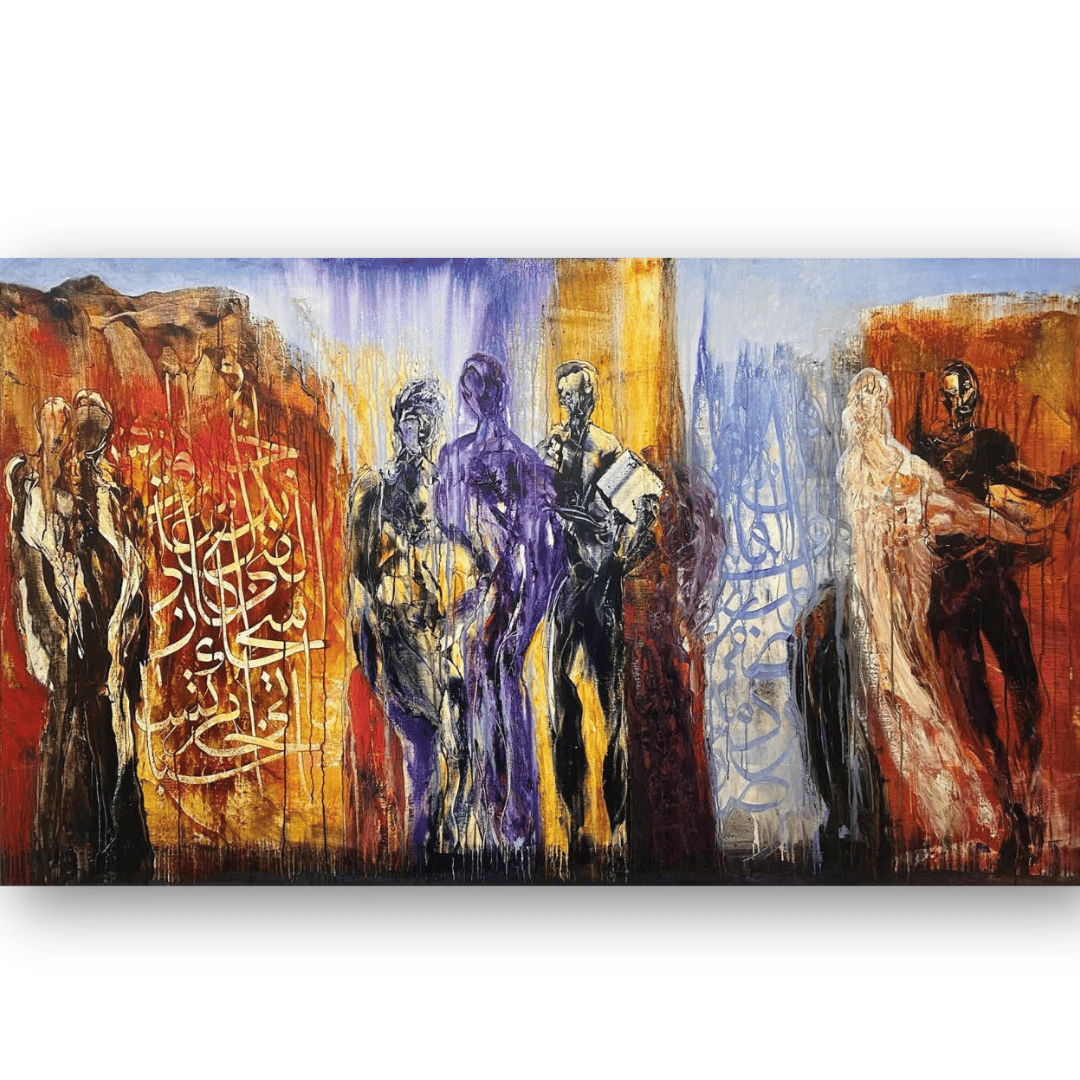
The formal structure of the work is built on a pronounced vertical rhythm, in
which human masses stand side by side within dense chromatic fields. The
painting thus appears closer to a sequence of visual segments than to a single,
unified scene. The vertical lines - through the flow of color and the elongation
of bodies - impose a sense of weight and enforced standing, lending the
composition a monumental, almost memorial quality, as if the figures were
human markers rather than living bodies. There is no horizon and no
perspectival depth; the surface itself becomes the field of confrontation.
Color plays an emotional rather than a descriptive role. Warm hues dominate
zones of tension, while cooler tones infiltrate the surface like unsettling
psychological layers. Color does not stabilize form but undermines it; it seeps
and erodes, as though the body were formed from color only to collapse back
into it. This disintegration reinforces a state of uncertainty and prevents the
image from reaching completion.
The figures are drawn with a strained, nervous line; their features are effaced,
their bodies elongated and semi-transparent. This strips them of individuality
and transforms them into generalized human conditions. There is no heroism
here, only a collective stance within a zone of trial.
Arabic calligraphy appears as an autonomous plastic mass, held in a tense
relationship with the body. It neither explains nor decorates; rather, it observes
and exerts pressure, creating a distance between the readable and the visible.
The letter functions as a visual conscience, reminding us that language - like
morality - is capable both of revelation and of pretense.
From this uneasy formalism, a verse by al-Mutanabbi emerges as an unstable
moral measure. The question is not posed through words alone but embodied
in the fragility of the form itself: are we witnessing an expression of an
authentic essence, or merely a representation? Here, ethics are transformed
into a visible trace - a fissure in color, a fracture in line - and the human being
becomes legible through the marks left by the body, rather than the values it
claims to uphold.

Ahmad Moualla
ahmad-moualla
Ahmad Moualla (b. 1958, Banyas, Syria) is one of the most influential figures in contemporary Syrian art. A painter, graphic designer, and professor, he studied at Damascus University and the…
View all works by Ahmad Moualla