Original artwork · Sold
Untitled 04
Dimensions
250x125 cm
Medium
Acrylic on Canvas
Certificate
Included
Price
73,000 
This work has been sold
Certificate of authenticity with every work.
Worldwide shipping. Professionally packed.
About this work
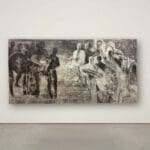
The scene unfolds as a dense theatre of division and alignment, resembling a
crossroads in the city where two roads intersect. Bodies stand side by side yet
collide at the same time, moving within a turbulent grey space where no clear
boundaries exist between right and left, nor between front and back.
Directions intersect and lose their conventional meaning, as if movement itself
has become a sign of bewilderment rather than an act of advance or retreat.
At the heart of this discordant crowd, a white figure emerges - more transparent
and fragile than the others - attempting to cross from one group to another. This
figure appears neither victorious nor defeated, but suspended in a moment of
perpetual transition, as if embodying the individual in search of a place amid
rigid collective divisions. Its whiteness is not an ideal purity, but a mark of
difference, perhaps even of isolation, within a dark environment of similar,
almost interchangeable faces.
Along the edges of the painting, groups condense into opposing human
masses, each with its own gestures and movements, without any religious or
political symbols, without signs that reveal their affiliations. It is as though each
group lives within its own narrative, unable - or unwilling - to see the other.
And yet, in the upper right corner of the painting, four musicians stand, visually
detached from the conflict, singing continuously without pause. Their presence
feels at once ironic and painful: a single song endlessly repeated, a fixed
melody rising above the divisions without healing them—and perhaps even
reinforcing them.
This painting does not claim to possess the truth; rather, it reveals its
multiplicity. Truth here is neither singular nor final. It is dispersed among faces,
movements, and conflicting directions. Each figure sees the world from its own
position and interprets it through a limited perspective. In this way, the painting
becomes a visual testimony to a divided society, bound together only by
constant noise and an inability to listen to the other - an endless song, and a
truth that can only ever be seen in fragment

Ahmad Moualla
ahmad-moualla
Ahmad Moualla (b. 1958, Banyas, Syria) is one of the most influential figures in contemporary Syrian art. A painter, graphic designer, and professor, he studied at Damascus University and the…
View all works by Ahmad Moualla