
Original artwork
Untitled 11
Dimensions
94x73cm
Medium
Acrylic on Canvas
Artist
Ahmad Moualla
Year
2020
Certificate
Included
Price
29,500 
Certificate of authenticity with every work.
Worldwide shipping. Professionally packed.
About this work
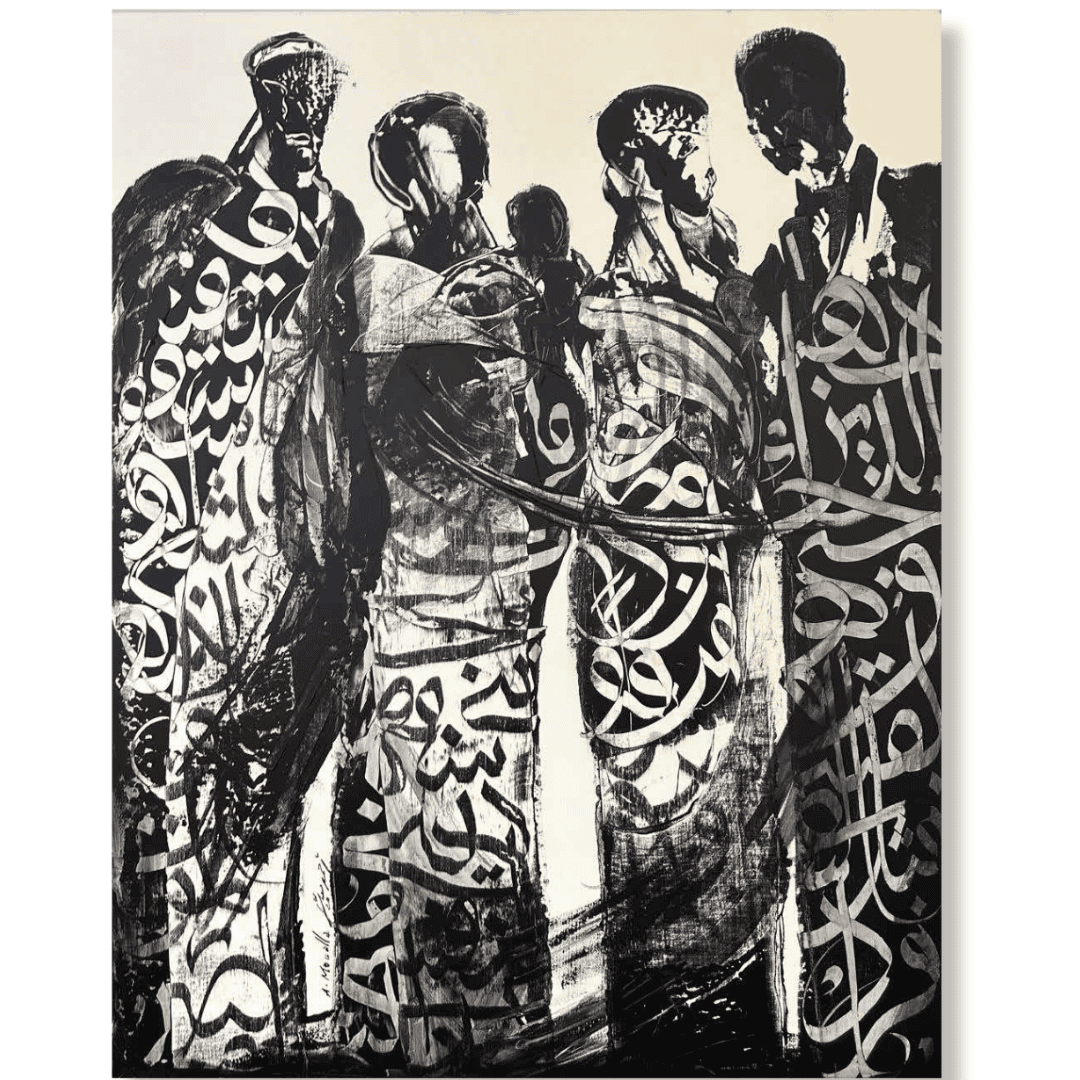
In this work, the figures do not appear as adjacent bodies, but as bodies
inscribed with Arabic poetic memory, stitching eras and centuries into a
continuous temporal fabric. Each body is a verse, and each verse becomes an
existential stance, carved into flesh and line alike. The right-to-left arrangement
traces a temporal and cognitive trajectory: from loss, to doubt, to individual
isolation, and ultimately to the confrontation with death.
At the far right stands the figure of Amru ibn Maadīkarib, bearing an unyielding
solitude:
“Those I loved are gone,
and I remain, like a solitary sword.”
Here, solitude emerges as a heroic fate. The body rises like a blade - upright yet
burdened by absence. Loss is not a fleeting emotion, but an ontological
condition that leaves the human being alone before time.
To his left appears Kaab ibn Zuhayr, suspended within doubt:
“We seem to speak only echoes,
repetitions of words already said.”
This is skepticism toward language itself. The script accumulates and curves, as
if meaning endlessly circles itself, trapped in an acute awareness of the erosion
of speech.
At the center, Abū Nuwās emerges:
“What have I to do with people, who foolishly press me so?
My faith is my own; the faith of others belongs to them.”
Here, the body withdraws inward, declaring a chosen isolation. The script coils
around the figure like linguistic armor, shielding the individual from the
collective and its judgments.
At the far left, the work reaches its climax with Zayd ibn Hāritha al-Kilābī:
“We gave them a cup, and they gave us one the same,
yet they proved more patient in the face of death.”
The body is taut, the writing sharp, marked by open conflict. The verse reveals
that victory belongs not to the one who strikes first, but to the one who
endures.
Here, Ahmad Moualla fuses the contemporary body with the ancient poetic
voice, transforming Arabic calligraphy into a vessel of time, struggle, and
awareness. The verses are not ornamental; they are open wounds, carrying the
same questions across centuries: what remains after loss, what endures of
language, and where does the human stand before death? A painting to be read
as much as contemplated, where the human figure becomes a living poem,
weighted with darkness and open to a fate bound to reality

Ahmad Moualla
ahmad-moualla
Ahmad Moualla (b. 1958, Banyas, Syria) is one of the most influential figures in contemporary Syrian art. A painter, graphic designer, and professor, he studied at Damascus University and the…
View all works by Ahmad Moualla